

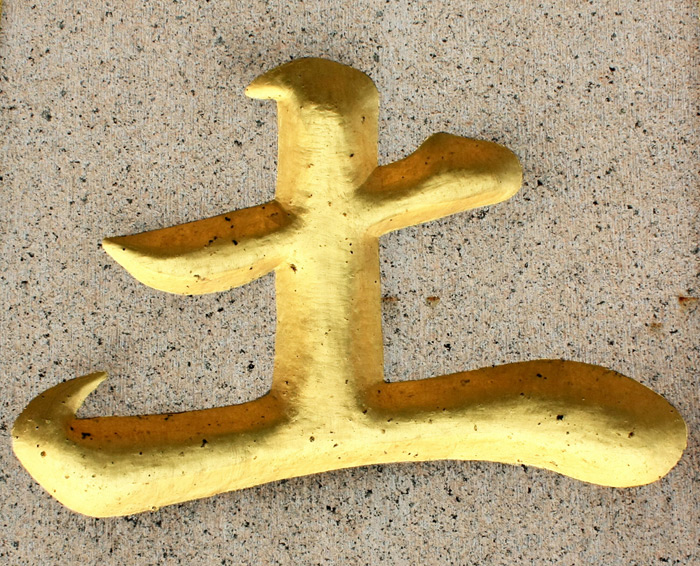
32. The "Earth" Radical: 土
With the "earth" radical, we have an ultra-simple shape, 土. But the more you investigate this radical, the more surprises you find—buried treasures, one might say.
Here's one surprise right off the bat: Nelson lumps radicals 32 (土: earth) and 33 (士: samurai) into the same category. That makes little sense to me. After all, the length of each top horizontal stroke greatly affects the meaning. Consider, for instance, the difference between these words:
土人 (どじん: native, aborigine) earth + person
士人 (しじん: samurai; person of extensive learning; person of great culture)
samurai + person
The first term here sounds quite derogatory, as the breakdown ("person of the dirt") suggests!
Anyway, I've chosen to treat the two radicals as separate entities.
Yomi, Position, and Shape
The yomi of the "earth" radical is fairly straightforward. In any position, you can call it つち, using the kun-yomi of the kanji 土 (60: earth, ground, soil, dirt). When this radical slides to the left of a character, it can also go by つちへん or どへん. The latter reflects the on-yomi of 土, as in 土曜日 (どようび: Saturday).
On the left, this radical becomes skinnier, and its bottom stroke angles up slightly:
城 (903: castle)
塊 (1065: lump, mass, clod; bundle, clump, cluster)
塚 (1607: mound, hillock)
If this compressed shape appears on the left side of a kanji, you can safely assume that it's the on-duty radical.
For the most part, the shape of this radical changes only on the left. When it appears on the right, 土 maintains its orthogonality:
吐 (1634: to spew, vomit)
Here, 土 is merely a component.
Similarly, 土 tends to hold its form at the base of a character:
堂 (557: hall; public building)
堅 (1217: hard, solid, rigid)
墨 (1821: black inkstick; black ink; Mexico)
When 土 is on the bottom, it tends to be the radical, as is true in this list. Noting how many other radicals are present in each kanji here, I repeatedly feel surprised that 土 prevails.
That's not the case in the next character:
掛 (1083: to set, hang)
Here we find two, stacked 土 components. The lower 土 angles upward, breaking ranks with the flatliners in the list we just saw. Despite the duplication in 掛, neither 土 is the on-duty radical. In fact, we can't even really consider them as autonomous components; this 圭 centerpiece is a solitary unit that pops up in several kanji.
Double the Dirt
According to Henshall, the non-Joyo 圭 (edge, angle; jewel) means "raised earth." It originally represented the "raised earthen paths that formed boundaries between fields." He says the idea of raised ridges led by association to "facets on a jewel." There's a poetic leap for you!
This extra-dirty shape lies at the heart of the following characters in which 土 is never the radical:
街 (819: city center; city streets; town)
Phonetically, 圭 expresses "to diverge" here. It also lends the idea of "multiple paths," which is to say "many diverging roads." That led to "many converging roads" (which seems like the same thing, just viewed from another direction), then "a hub of activity," which is a town.
佳 (1044: fine, excellent; beautiful)
In this kanji, 圭 means "edge; jewel." It also acts phonetically to express "beautiful" and possibly "jewel."
涯 (1069: outer limits; horizon; edge; shore)
Here, as before, 圭 means "raised earth," which is to say "cliff."
崖 (1977: cliff, precipice)
Once again, 圭 means "raised earth."
There are exceptions to everything, and this discussion is no exception! Etymologically, 圭 plays no role in the following character:
封 (1762: to seal; closing)
This 圭 is not a doubling of "earth" but rather a "bushy, branched tree" whose shape has changed.
Disguised as Dirt
Just as the left side of 封 misleads us into identifying it as 圭, it's easy to think that a kanji contains 土 when the radical is actually a larger shape:
産 The radical is 生 (radical 100: birth).
致 The radical is 至 (radical 133: arriving).
赦 The radical is 赤 (radical 155: red).
越 The radical is 走 (radical 156: running).
野 The radical is 里 (radical 166: village).
青 The radical is 青 (radical 174: blue).
Here are the meanings of those kanji:
産 (491: to give birth; produce)
致 (1573: to bring about)
赦 (1336: forgiveness)
越 (1021: to cross over; exceed, surpass; move; Vietnam)
野 (213: field)
青 (43: blue)
Simplification and miscopying can also make us treat a shape like dirt when, etymologically, it isn't dirty at all. The "earth" radical does not appear in the following characters:
先 (49: ahead)
寺 (133: temple)
去 (258: to go away)
周 (504: periphery)
素 (737: element)
The component search display in Denshi Jisho can reinforce the incorrect idea that such characters contain 土. For example, Denshi Jisho says that 寺 includes 土 and 寸. However, this list of shapes is only a tool to help people locate characters; it's not a reflection of etymology.
You may be starting to distrust your impulse to see "earth" in complex characters. If so, you could easily overlook the dirt that actually exists in the following kanji:
報 (789: to inform; report)
Would you think the on-duty radical is 辛 (radical 160), 卩 (radical 26), or maybe 又 (radical 29)? Nope! It's 土!
Surprise!